
When news of the world's first solar-powered ambulance being tested in Kenya emerged, it was easy to see it simply as another exciting clean-energy innovation.
But there is a much bigger engineering lesson here.
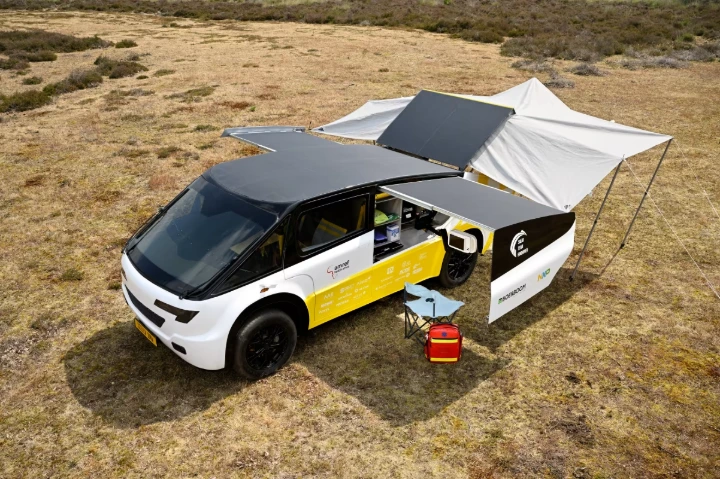
The vehicle, known as Stella Juva, was developed by students from Solar Team Eindhoven at Eindhoven University of Technology. Unlike a conventional ambulance, it is designed to bring healthcare equipment and energy directly to remote communities where electricity, fuel and healthcare infrastructure can be difficult to access.
During testing in Kenya, Stella Juva travelled more than 800 kilometres through remote areas of Narok County. The vehicle carries equipment including an ultrasound scanner, portable X-ray equipment, an automated external defibrillator and refrigeration for medical supplies. Its solar panels charge a 50 kWh battery, while additional panels can be extended when the vehicle is stationary.
The important idea isn't simply that the ambulance runs on sunlight.
It's resilience.
When a critical system cannot depend completely on a fragile external infrastructure, engineers have to rethink where power, data and essential services come from.
And that lesson applies far beyond healthcare vehicles.
1. The Flaw of Fragile Systems
Modern businesses and healthcare organizations often operate through a collection of interconnected systems.
There may be one application for scheduling, another for documentation, another for billing, another for communication and another for reporting.
Individually, each tool may work perfectly well.
The problem appears when they have to work together.
A weak internet connection can interrupt access to critical information. A failed integration can stop data from moving between systems. A power outage can take an entire workflow offline.
The same basic challenge exists in remote healthcare.
If a clinic depends on an unreliable electricity supply, access to diagnostic equipment, refrigeration and other essential services can become difficult.
Stella Juva approaches the problem differently.
Instead of assuming that reliable infrastructure will always be available, it carries both energy and medical capability to the location where they are needed.
That is an important systems-engineering principle:
Don't simply design for ideal conditions. Design for the conditions your system will actually encounter.
2. Translating Physical Resilience Into Digital Systems
The same principle can be applied to healthcare software.
Consider the relationship between a solar-powered mobile healthcare system and a modern healthcare operations platform.
| Solar Ambulance Principle | Digital Healthcare Equivalent |
|---|---|
| Local solar generation | Data and workflows designed to remain useful even when connectivity is limited |
| Battery energy storage | Reliable local data storage and continuity of operations |
| Medical equipment carried directly to remote communities | Critical healthcare workflows brought together in one platform |
| Reduced dependence on fuel and external infrastructure | Reduced dependence on multiple disconnected software tools |
| Designed for challenging environments | Designed around the realities of frontline healthcare workers |
This is where resilient software architecture becomes important.
A healthcare worker shouldn't have to fight with five different systems just to complete a single workflow.
A platform should make it easier to capture information, verify visits, manage workflows and keep operations moving.
That is the thinking behind Digitech CareFlow OS.
Instead of forcing healthcare organizations to manage a collection of disconnected tools, CareFlow OS is designed to bring important operational workflows together in one environment.
3. Why Offline and Resilient Systems Matter
Imagine a healthcare worker entering a building with poor cellular reception.
They still need to complete their work.
They may need to document a visit, record information, verify a shift or update operational records.
A system that assumes perfect connectivity can become a liability in that environment.
Resilient systems take a different approach.
They consider what happens when:
Internet connectivity disappears.
Power becomes unreliable.
A third-party service stops responding.
A device temporarily loses communication.
A healthcare worker is operating in a difficult environment.
The goal isn't to eliminate every failure.
The goal is to design the system so that one failure doesn't bring the entire operation to a halt.
That is one of the most valuable lessons from engineering systems for real-world environments.
4. Healthcare and Clean Infrastructure Are Converging
The solar ambulance also highlights something larger.
Clean energy and digital healthcare are increasingly connected.
Reliable energy can support:
Medical equipment
Vaccine refrigeration
Diagnostics
Lighting
Communications
Digital health infrastructure
At the same time, reliable software can help healthcare organizations coordinate the people, information and processes that make those services useful.
One solves an infrastructure problem.
The other solves an operational problem.
Together, they contribute to a more resilient healthcare system.
Stella Juva demonstrates what happens when engineers stop asking, "How do we make this work under ideal conditions?"
And start asking:
"How do we make this work where the infrastructure isn't ideal?"
That shift in thinking is important not only for healthcare in remote communities, but for businesses everywhere.
5. The Bigger Lesson: Engineer for Reality
Whether you're designing a solar energy system, a healthcare platform or a business operation, the principle remains the same.
Real environments are unpredictable.
Networks fail.
Power goes out.
Equipment breaks.
People work in places where conditions aren't perfect.
The strongest systems aren't necessarily the ones with the most features.
They are the ones designed around reality.
That's the lesson we can take from Stella Juva: resilience isn't an extra feature. It is part of the architecture.
Take Control of Your Practice Infrastructure
For healthcare organizations, operational complexity can quickly become expensive.
Multiple systems, disconnected workflows and manual processes can make it harder for teams to focus on what matters.
Digitech CareFlow OS is designed to bring essential healthcare operations together in one platform, helping organizations manage workflows such as electronic visit verification, shift compliance and billing.
Explore CareFlow OS
For organizations looking at reliable energy infrastructure, Digitech Explorer also provides solar and power solutions designed around real-world energy needs.
Explore PowerUp Solar Solutions
Final Thought
The solar ambulance isn't just a story about putting solar panels on a vehicle.
It is a story about bringing critical infrastructure closer to the people who need it.
And that same philosophy can be applied to software.
Build systems that expect disruption.
Build systems that reduce unnecessary dependencies.
Build systems that keep working when reality doesn't follow the plan.
That's the physics of uptime.
Explore CareFlow OS → CareFlow OS